

BLOG

8 top tips on managing and motivating a remote team
Managing and motivating a remote team requires the development of strong team dynamics. Here are our top eight tips on how your team cannot only survive but thrive in the current environment.
A challenge for teams now working remotely

Developing strong team dynamics
Webinar on May 20th 2020 11:00 -12:00 & June 4th 2020 14:00 - 15:00.
The current pandemic has brought about change to many workplaces at an unprecedented rate. Teams that once worked physically together are now working remotely and learning how to collaborate virtually. Fortunately, there are many tools and systems that can encourage remote collaboration.
However, remaining focused and productive can be a challenge for teams who are unaccustomed to working remotely and miss the social aspect of office life. Equally, for managers used to sharing an office with their team and seeing them face-to-face on a regular basis, providing effective management remotely can be difficult. Managing and motivating a remote team requires the development of strong team dynamics. Here are our top eight tips on how your team cannot only survive but thrive in the current environment.

Work towards a shared purpose. Think creatively.
1. Revisit and communicate your team’s purpose
A common purpose unites a team, regardless of how geographically dispersed the members may be. The pandemic has created change and uncertainty not only in the way we are currently working but across all aspects of everyday life. If your team’s purpose has changed, now is the time to communicate this and update employees on what the new normal will look like. Everyone needs to understand the new focus and be working towards a shared purpose, behaviour and objective.
Work with your team to identify and understand short- or long-term project constraints.
Create a team charter as a "roadmap" to help paint a compelling picture of the future that will inspire team members to persevere. Not only will this motivate the team to look forward beyond the now, it will also provide clear decision-making guidelines for all members of the team.
Think broadly and creatively to spot new opportunities to pivot your team for future success.
Now more than ever it’s important to be transparent about the current situation, share what you know and if things are still unclear share this information too. Honesty and transparency will continue to engender trust between you and your team in these challenging times.

Learn about everyone. Understand they all have different needs.
2. Learn about every member of the team
Many of us leave our troubles at home when we head into work, however when having to work from home this option disappears. Remote working will prove challenging for all team members in one way or another. Some will have additional responsibilities such as childcare, home-schooling or caring and shopping for a vulnerable family member. Other team members may live alone and be battling loneliness. This is unprecedented times and being socially distant from our support networks is a struggle for all of us.
Lead the way by providing both practical and emotional support, but also encourage team members to be considerate to one another. This is an opportunity to reset or improve relationships.
Ensure team members have the support and equipment they need to work effectively. This includes any training they may need to use online systems and applications.
Has your company used psychometric tools such as INSIGHTS or MBTI to understand preferred ways of working? If so, encourage the team to revisit these in the context of the new environment so they can consider and share what helps them to work effectively.
Look for warning signs that employees may be struggling such as reduced output; short and abrupt emails; reluctance to engage in telephone calls or video conference calls; shortage of new ideas.
One of the most upsetting aspects of lockdown is an increase in domestic abuse, staying at home isn’t safe for everyone. If you are worried, check-in regularly with the team member so they know they are supported and provide details of appropriate professional help in their area.

Make sure you are available. Keep lines of communication open.
3. Be available for your team
Now more than ever, clear, honest and open communication is absolutely vital.
Send emails or post videos about your reasoning, intentions and expectations.
Encourage collaboration by making it easy for your team to know your thoughts and contribute their own.
Have a daily virtual huddle to keep connected as a team, to check-in on each other’s well-being and keep workflow on track. It needn’t be long, but regularity is key.
Keep the rhythm of regular one-to-ones going as these are the best place to help support your team and identify if they are struggling and need more support.
Role model the approach you want the team to take. As a leader, you control the weather. How you behave will influence how your team operates.

Manage team relationships. Keep them on task.
4. Manage team relationships
Managing relationships between team members can be challenging enough within a shared office space. With the team now working remotely, it creates a whole new dynamic and previous ways of working may no longer be applicable. The team may go through a new 'forming, storming, norming, performing' cycle as they learn how to work together remotely. Now is the time to consider which stage your team is in and develop practical steps to move them towards the performing stage. Productivity is not only good for business, it’s important for morale, we all want to feel like we are achieving something.
Encourage informal meetings, information sharing, and huddles between team members. This is not only a great way to brainstorm ideas but it also prevents feelings of isolation and any negativity from creeping in.
Continue to build a learning team. Get everyone to sign up to a webinar and share their learning or invite someone from another team or a supplier or customer to share their expertise. This pandemic has driven an unprecedented change but in the long-term it can result in stronger relationships - across teams, supply chains and with our customers.

Aim for speed over perfection.
Trust your teams to make decisions and act on them.
5. Find a balance between speed and perfection
Most organisations do not have the systems and analytics necessary to deliver perfect information on how their business operations will be impacted by a global pandemic. There will be many unknowns and plenty of ambiguity. Learning to accept and adapt with imperfect information will be key to your team's success.
Counter balance the ambiguity by using creative thinking tools such as brainstorming, mind mapping or six-thinking-hats to generate possibilities. Then move swiftly into action by executing on your top three ideas.
Devolve decision making by encouraging your team members to take the initiative and trust them to develop creative approaches to problems or opportunities.
Focus on clarifying the objectives that matter and the lines that cannot be crossed to give your teams space to respond to the new normal and to innovate.

Give feedback and reward performance.
6. Give feedback and reward performance
Providing feedback is always important however in the current climate people are likely to be more sensitive if they’re feeling isolated or anxious.
Tailor your feedback, whether its praise or criticism, to take this into account when talking or writing.
Ensure you communicate regularly, not just when things go wrong.
Check your biases: Are you giving fair and honest feedback? Is your feedback too ‘soft’ because you want to be liked, or too ‘hard’ because you haven’t given clear instructions or provided the right resources?
Be specific, it’s rarely helpful to give vague or ambiguous feedback to remote workers, whether it’s positive or negative.
Let your team members know exactly what performance traits you want them to continue. “That report was really well researched and organised. It will help us understand which customers we need to contact immediately".
Ensure you are inviting two-way communication, this will help you understand if your feedback has been understood and accepted. A new perspective may help you to see things in a different light.
Here’s a fun exercise for teams to illustrate what it feels like when you are working blind and not getting any indication of how well you are doing: Pens in a Box.

Focus on goals not activity. Manage expectations.
7. Focus on goals not activity
It’s important to manage expectations and remain focused on goals when managing a remote team. Concentrate on what is being accomplished, rather than how working hours are being used. Trust your employees to work independently and hold themselves accountable for their work. If a situation arises where an employee isn’t performing, then you can consider increasing supervision.
Rather than expect your team to work 8 to 5, understand their constraints and allow them the flexibility of structuring their day as this will enable them to be more productive. One of the advantages of working from home is having the flexibility to work around commitments that are in conflict with an eight-to-five routine, such as childcare and home-schooling. Agree some overlapping time for meetings and accept any video calls may include the occasional child or pet!
Research suggests the stereotype of the laid-back remote worker lounging on the sofa, watching TV, gaming or surfing the internet are not only unfair but inaccurate. In most cases, remote workers are diligently performing and, in some cases, taking fewer breaks and switching off far later from work. So, focus on what your team is accomplishing in their new way of working and not any negative stereotypes.

Take care of yourself. Don't work day and night and keep to core hours.
8. Take care of yourself
You are the vital linchpin holding all this together, so take care of yourself! Your leadership, skills, knowledge and talent are vital to your team now more than ever, so ensure you prioritise your own health and wellbeing.
Be aware of working longer hours, decide on your core hours and stick to them.
Remember to ask for support when you need it. Maintaining the welfare and performance of your team is a huge responsibility so ensure you have a support network.
Look for people to learn from both within your organisation and outside of it. Talk to them, ask for advice, and listen carefully. Consider looking for a mentor or a coach.
Sorry … Blatant sales pitch from Treehouse 😊. We run tailored Executive Coaching courses – get in touch if you are in need of a boost!!
Look to the future
Many organisations have achieved the impossible by remotely enabling a workforce in just days. Managers and employees have stepped up and are performing in challenging times. Take a moment to congratulate yourself on getting this far, on adapting to a truly unique situation so quickly. Consider what has worked well for your team and what could be improved upon. Most importantly, keep in mind that the unique situation caused by the global pandemic will one day end. The result of all your efforts will be stronger more emphatic relationships based on mutual respect and trust.
Further Reading:
If you want tips on how to prioritise your time, set goals and work productively, why not read the Treehouse guide on How to stay focused working from home.
Developing Strong Team Dynamics
Webinar on May 20th 2020 11:00 -12:00 & June 4th 2020 14:00 - 15:00.

Top tips to help you work from home productively
Whether you are a seasoned pro or a newbie to working remotely, these are challenging times. Here are some top tips to help you stay efficient and avoid going stir-crazy.
Top tips to help you work from home productivelY without impacting your personal life
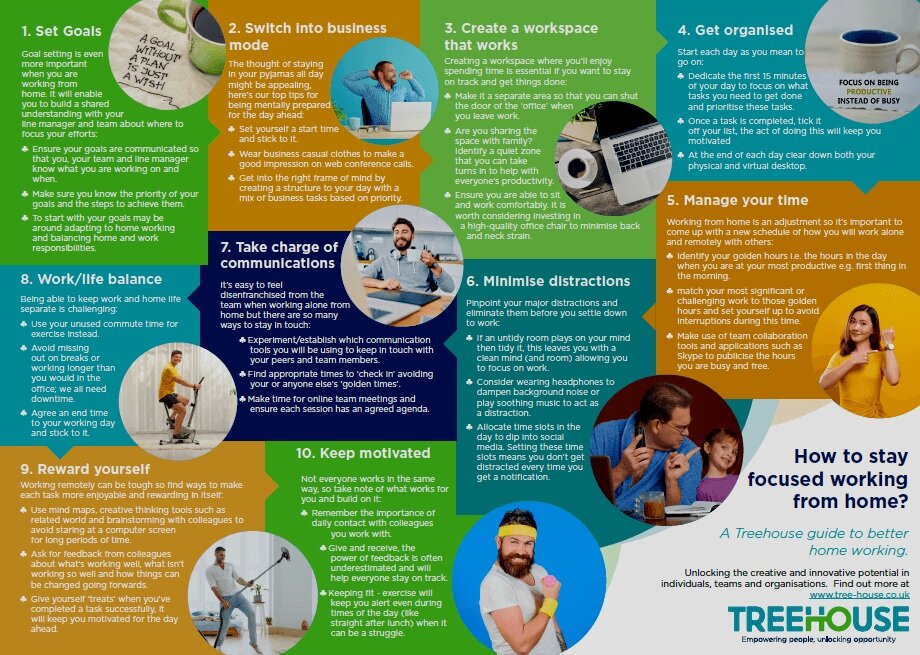
10 Top tips for staying focused working from home
Download our Infographic
The world has suddenly changed overnight and completely without warning.
Many people have unexpectedly found themselves working from home, some for the first time in their professional lives. Whether you are a seasoned pro or a newbie to working remotely, these are challenging times. Here are some top tips to help you stay efficient and avoid going stir-crazy.
1. Develop a healthy work/life balance
One of the challenges with working from home is work and home life merge. Before you know it, you are starting work early, finishing late and not taking many breaks during the day. Not only is this not healthy, it becomes really unproductive.
Use the time you would have spent commuting to fit in some exercise. A morning workout is perfect for getting mind and body energised and ready to be productive.
If during the course of the day you find yourself losing focus, check that you're not pushing yourself too hard.
Don’t overcompensate for not being in the office by working longer and missing breaks, everyone needs a bit of downtime.
Agree an end time for your working day and stick to it.
Make plans for your after-work hours with friends and family, or dedicate time to your hobby or exercise. If you have something planned for the end of your workday, you'll be more likely to log off and stop working.
2. Switch into business mode
The thought of staying in your pyjamas all day might be appealing but it doesn’t mentally prepare you for the day ahead. Also, it’s not a great look on web conferencing calls! Set yourself a start time for the day and aim to be showered and dressed by this time every working day. Not only will this provide a structure to your day but it will help you get into the right frame of mind to crack on with your job.
3. Create a work space
Creating a space where you can set yourself up for the day is absolutely vital to your productivity. Ideally, your workspace would be in a separate area to where you and other members of the household relax, prepare food or sleep. This would limit the number of interruptions and help everyone’s productivity! A room like a spare bedroom or dining room where you can close the door and transition into work mode would be perfect. However, if this isn’t possible, identify an area in your home where you can easily set up and pack away your work items at the start and end of each day.
Comfort is important, so check you can sit comfortably, that your screen/keyboard is at the right height. If working at a laptop, it might be worth investing in a screen, keyboard and mouse if the remote working scenario is to become more permanent. It is also worth considering investing in a high-quality office chair to minimise back and neck strain.
4. Get organised
Start each day as you mean to go on by dedicating the first 15 minutes of your working day to focus on what you need to get done. Review your tasks and set priorities of what needs to be completed by the end of the day. Use whatever system feels right for you; whether that be pen and paper or an app.
Once a task is completed, tick it off your list, the act of doing this will keep you motivated.
At the end of each day, spend a few minutes clearing down your physical and virtual desktop. File away or delete any emails that are resolved, make notes for activities you might be in the middle of, file away documents and clear away empty coffee cups.
With a clear mind and clean work station you can walk away from your desk and switch off for the day.
5. Set goals
Setting yourself targets and goals is always good practice however it’s even more important when working from home.
Having a clear goal will enable you to build a shared understanding with your line manager and team on what the priorities are and where effort should be focused. Additionally, the key to productivity and achieving goals is ensuring you have access to all the applications, tools, systems and documents that will enable you to work effectively and productively from home.
We are in unprecedented times; some companies are better prepared to remotely enable the workforce than others. So one of your goals could be adapting to home working and collaborating with your colleagues to ensure everyone is set up in the best way to work together.
6. Manage your time
Working from home is an adjustment so it’s important to come up with a new schedule of how you will work alone and remotely with others. Identify the hours you are at your most productive, for example early mornings or late afternoon, these are your golden hours. Match your most significant – or most challenging – work to the time of day when you're at your best and avoid interruptions during this time.
Team collaboration is important in many roles however this doesn’t mean you are available to be interrupted at all times. Use whatever tools or applications available to publicise the hours you are busy and when you are free so that team members can be mindful and respectful of your time.
7. Minimise distractions
Pinpoint your major distractions and eliminate them before you settle down to work. If an untidy kitchen is an irritation preventing you from concentrating and prioritising work, then clean the kitchen! This will leave you with a clean mind (and kitchen!) allowing you to settle down and focus on work.
Many home workers find that playing music or an audiobook during the work day helps to increase their focus. For others, only total silence will do. If your home environment has lots of distracting background noise, consider wearing headphones to dampen the sound.
Social media can be a huge distraction, so think carefully about how often you are dipping in to various apps. Consider allocating time slots, for example morning, lunch time and at the end of the day rather than dipping in and out throughout the day. Additionally, decide which notifications to keep on, and which to mute until later.
8. Take charge of communications
It’s easy to feel disenfranchised from the team when working alone from home but there are so many ways to stay in touch. In the early days you will probably need to experiment with communication tools and find appropriate times to "check in" with your peers and team members. Aim to avoid unnecessary distractions, but equally don’t "disappear."
Make time for online team meetings to manage communication, prepare an agenda but also allow space and time for questions. Over time, you'll discover the right levels of interaction and this will build collaboration and trust within the team. It will also combat any micromanagement from managers who previously may have relied solely on presenteeism to manage the team.
9. Stay motivated
Not everyone works in the same way, so take note of what works for you and build on it. Suddenly shifting to working from home is a big change, so make whatever adjustments needed to help you relax into your new working arrangement. Working from home is very different to working in an office, it’s easy to underestimate the importance of daily contact with colleagues that you regularly work with. Use online tools to keep in touch and make time to speak to colleagues over the phone or using WhatsApp, FaceTime or Skype. This not only helps with productivity it also boosts morale.
10. Reward yourself
Find ways to make each task more enjoyable and rewarding in itself. Use mind maps, creative thinking tools such as related world and brainstorming with colleagues to avoid staring at a computer screen for long periods of time. Ask for feedback from colleagues about what's working well, what isn’t working so well and how things can be changed going forwards.
Lastly, give yourself 'treats' when you've completed a task successfully; enjoy a cup of your favourite coffee, dance to a top tune, plant seeds in a window box or have a slice of cake!
Disclaimer: If you do reward yourself with a slice of cake, don’t forget our advice in point 1 about exercise….

Pens in a box Feedback Exercise
Ever felt you aren’t getting any feedback on the work you do? Even the extent where you do know if the work you’ve done is right or wrong?
Pens in a Box
Ever felt you aren’t getting any feedback on the work you do?
Do you know if the work you’ve done is right or wrong?
What happens if the only feedback you give is good feedback? Is it the same?
The pens in a box exercise aims to illustrate what it feels like when you are working blind or not getting any indication of how well you are doing?
Who is this exercise for?
Pens in a box is great for people in management roles e.g. team managers, project managers, scrum masters and other similar positions. The main aim is to convince that in-the-moment feedback is essential on both 1-2-1 or group levels, and best not saved up for review meetings. And also what the implications are when no feedback is given.
The Object
The objective of the exercise is for a thrower to get as many pens in the box as they can. The thrower stands on a spot and throws the pens in the box whilst blindfolded.
Ask for three volunteers to be the throwers.
They leave the room while you brief the rest that no-one may say anything to the blindfolded person. The first blindfolded person then comes back in and stands on the spot and tries to throw the pens in the box.
Now brief the rest that they are only allowed to give positive encouragement. The second blindfolded person comes back in and stands on the spot and tries to throw the pens in the box.
Now brief the rest that they are allowed to answer any of the blindfolded person’s questions fully. The third blindfolded person comes back in and stands on the spot and tries to throw the pens in the box.
What did you observe? Did they get any pens in the box?
How did each of the blindfolded people feel?
How does everyone else feel when they see no feedback is given?
What parallels can you draw with how you give feedback?
The Implications
What are the implications of not giving feedback, here’s an extensive list. Individuals can feel:
no one is caring about the work they are doing nor the quality
de-motivated
isolated
not valued
there is no means of asking for help
left in the lurch
they are being dumped on
vulnerable, is their position at risk?
frustrated
they are flying blind
stressed, particularly if they don’t know how to do the work given
upset and angry, when the manager does the work for them
and more!

Feedback is gift, if you truly value your people then they deserve it.
Helen Westendorp, Treehouse
More Reading
Related worlds
Have you ever struggled to find a solution to a problem? You’ve gone round and round the houses, but end up back at the same place. Well now consider this, who or what else has already solved the issue?

Finding Solutions to Problems
Have you ever struggled to find a solution to a problem? You’ve gone round and round the houses, but end up back at the same place. Well now consider this, who or what else has already solved the issue?
A great example of this type of thinking is the connection between fighter jet pilots and giraffes.
Fighter jet pilots can pull up to 9G vertically, which as thrilling as it may be, makes them vulnerable as the force pushes all the blood from their brain to their feet causing them to pass out - ultimately effecting their chances of survival in a dog fight. So, how can we stop blood pooling at the feet? This is where we look to giraffes!
Have you ever wondered how a giraffe stops itself from passing out?
Giraffe’s are about 5 metres tall and the pressure differences between the top of the giraffe’s head and the bottom of it’s feet can reach over 1,000 pounds a square foot - so how an earth do they avoid passing out? Well, the secret is the extremely tight skin on their legs - this forces the blood to stay up towards the heart and the brain, avoiding any pooling at their feet!
So why might this information be useful to a fighter pilot?!
Using the physiology of a giraffe, a G-combatting suit was created, worn by both combat pilots and also astronauts. When you pull a G-force manoeuvre the suit pressurises, squeezing your legs, pushing the blood back up to the brain so that the heart can’t pump it downwards, and that’s how we retain the blood in our brain and remain conscious.
This is a great example of our related world tool – where you ask a clear question and then look for who or what else has solved that issue or similar, in this case the giraffe.
It’s amazing to think that giraffes have helped fighter pilots - who would ever have imagined?!
Giving your brain time to think
Have you ever found it hard to focus? Or struggled to find the space to give your brain time to think? If so, have you ever thought about sitting with a cardboard box on your head?! Believe it or not, one of my clients swears by this technique…

Finding the time to focus
Being in an open plan office is distracting - I’ve seen the brain scans to prove it! Your brain simply doesn’t work as well as it could.
Have you ever found it hard to focus? Or struggled to find the space to give your brain time to think? If so, have you ever thought about sitting with a cardboard box on your head?! Believe it or not, one of my clients swears by this technique! Whenever he needs time to think, he pops a box on his head to help channel his thoughts.
Now I’ll admit, this is a somewhat unorthodox way of helping you re-gain focus but by giving your brain time to think you can release the power of your unconscious mind, making spontaneous connections and thus increasing your productivity.
Create yourself some space
Taking space is something we do automatically in our downtime and sleep, but frequently in the world of work and in our busy lives, we don’t have enough space, so the power of our unconscious is underused. We often feel it is irresponsible or lazy to give ourselves space, but that space is in fact, exceptionally productive.
Space gives your unconscious brain time to think. Instead of constantly pulling information into your conscious brain, you take some space to ensure your brain can properly process and distil matters, enabling you to make new connections between seemingly unrelated thoughts — and allowing a bubble of insight to surface. Without space we’re simply not as smart!
Take some downtime
Taking some time out or downtime is an incredibly powerful aspect of the creative process. That space harnesses your brain’s power to come up with that lightning bolt of inspiration!
Whilst putting a cardboard box on your head may not be your thing, try building space into your daily routine. Get into healthy habits that work well for you whatever you’re doing and wherever you are. As a simple example, you might spend 20 minutes going for a walk after every 90 minutes of concentrated deskwork: this is taking space. Acquire good sleeping habits and good posture. Eat healthily and do regular exercise. Learn stress control and mindfulness practices. Enjoy life and be playful. Hug your partner. Appreciate humour, wit and laughter. Keep your brain active by doing puzzles and stretching your memory. Keep learning. And even on the busiest days you can always go and make a cup of tea!
Brick walls
You know you’ve hit a brick wall when you’ve reached a point at work where you’ve got a problem that you can’t see your way around. You’ve tried over and over again, but no luck. You find yourself hitting your head against a brick wall. We’ve all been in that situation…

Those problems you can’t get around
You know you’ve hit a brick wall when you’ve reached a point at work where you’ve got a problem that you can’t see your way around. You’ve tried over and over again, but no luck. You find yourself hitting your head against a brick wall. We’ve all been in that situation.
The key is to remember “if you stop hitting your head against the brick wall, the pain goes away”.
How to tackle brick walls
Here’s a tip to how I tackle this situation:
The first step is recognising you are doing it? Recognise that’s where the pain is.
Stop and take a break. Have a cup of tea or a chat with a colleague. Maybe go for a walk.
Think about what the problem is and not how to solve it. What’s the real problem? Articulate it so that it is clear in your head, what the problem is that you are trying to solve.
Is it the problem, or is it the symptom? Is there a deeper problem underlying the one you have recognised? If you fix that would it make a big difference to the situation?
Think about what’s causing the problem to continue being a problem? Define the root of the problem.
Try tackling one of the symptoms of the problem to try and and help. You may find yourself in a different place.
Step back and Re-Energise
By redefining the problem you may find another way around it. Once you have taken a step back, relaxed and re-energised you will think more objectively about the problem and be able to come up with new ideas and solutions.
So in summary: Stop, take some time out and get some new stimulus into your brain. You won’t solve the problem by banging your head against a brick wall.
Health & Well Being
We often find that those working in high pressured jobs tend to work all hours under the sun, constantly firefighting the challenges they are faced with and never feeling like they have the time to really slow down or stop. Sound familiar?

Pressured environments
We often find that those working in high pressured jobs tend to work all hours under the sun, constantly firefighting the challenges they are faced with and never feeling like they have the time to really slow down or stop. Sound familiar?
At times like these, although it may feel like you are doing the best you can, the likelihood is you’re burning out, not thinking straight and therefore you can’t apply your skills and knowledge efficiently or effectively.
Give yourself space, take a break
Despite there never seeming to be enough hours in a day, it’s important to take a break – grab some food, go for a walk, chat with a friend - try stopping, even if just for 5 minutes and take a step back. You’ll be surprised by the results!
Overworking makes for an unsustainable work/life balance, where both sides of the balance are affected, and not in a good way. To be truly productive it’s important to make sure you take time out!
The Insight Gift
How much do you really know about your customer? If you had to buy them the perfect gift, would you know what to get?

Get to know your customer
How much do you really know about your customer? If you had to buy them the perfect gift, would you know what to get?
Imagine you’re buying a present for someone you don’t know very well…you might choose some wine or a nice box of chocolates, as you know you can’t really go wrong with these! But, had you have known them better, you could have bought them something a little more personal – maybe some new trainers to help with their upcoming marathon or a new paintbrush that really helps with their usual style of painting. It’s far more meaningful and shows you’ve really thought about them!
So, why not take five minutes out to get to know your customer? Ask them a few open questions like, ‘What do you get up to in your spare time?’ or ‘If you could wave a magic wand, what would you do?’.
Understanding what makes your customer tick
Gaining insight allows you the opportunity to offer the perfect gift. For example, if someone hardly sees their partner because of their job and commitments to their kids, the offer of a trusted babysitter and a weekend away would fill them with joy! By posing this more insightful, thoughtful present, they feel a sense of being treasured and understood. You’ve spent time thinking about them and helped solve a problem.
Offer your customers something meaningful
It’s important to know what makes your customers tick, so that what you can offer them is meaningful and they’ll take you up on it without even thinking.
Think about your business or product as a gift – what do your customers really want? Not something typical that you’d offer to others, but something they’d find really compelling.
They’ll bite your hand off for it, they’ll remember you and they’ll come back for more. That’s the gift of insight.